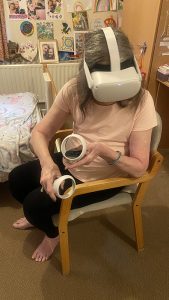
Since Unit3, I began to confuse my problems. If loneliness that I cannot intervene, and Extended Reality is just a new thing in an attempt for the elderly, and it cannot be measured, do my research fail? When I express my thought, David told me that when I have ideas for success or failure, my focus is on solving the problem, not on exploration and learning.
Also, I’m thinking about my prejudices and assumptions. How to avoid my research being influenced by my hypothesis
。 I think I need more investigation.
David’s suggestions——some further points of consideration:
1) Don’t focus on or try to predict or ‘second-guess’ the outcome of your research actions – that is not the role of research. The role of research is to identify, explore, investigate and understand an issue and the challenges it creates to formulate a question (enquiry) around it; and develop from that question a series of interventionsthat tests and measures your question: to formulate, demonstrate and evidence a better understanding that could developed into becoming a solution.
2) Don’t try to answer your question yourself – let your stakeholders/experts/target audiences provide your answers, so that you can interpret, analyse and evaluate their answers, responses and reactions to your research question through their interaction with your intervention.
3) Use negative results to your advantage – analyse, evaluate and articulate what went wrong, why and what you can do to improve it for next time. This level of analysis improves the value of your research enquiry and uses all aspects of what you have done, so nothing is wasted. Don’t edit out negative stuff – use it! Otherwise your research will appear unrealistic and biased towards your conscious and unconscious prejudices.
4) The role of your intervention is to test and measure your question; no question no intervention. Your research questions brings focus and context to your intervention. It can develop, evolve and/or change but it must be present and evident in all you do in your research enquiry.
5) Declare your biases and prejudices – embrace them, understand them and how they influence your thinking and affect your interpretations of the research data and associated theory. This will help you present a more balanced and objective view and approach to your research enquiry and development.
6) Consider acknowledging the role and impact of COVID-19, if and where relevant, on your stakeholders and target audiences at some point in regard to how it contextualises, challenges and or provides opportunities within your research enquiry. Pretending that it doesn’t exist and is not having a long term impact would be an oversight given its global and far-reaching impact.
Think about using key words in your question that aim to quantify what you are trying to do (action), as well as describe the thing you are researching (thing, object, happening, interaction, behaviour) and its context (place, location, time frame, environment, situation, active forces), such as:
Enquire, Investigate, Quantify, Measure, Scalability, Resistance, Acceptance, Adoption, Evaluate, Explore, Elaborate, Compare, Contrast, Evolve, Ignite, Emerge, Phenomenon, Event-scene, Instigate, Improve, Shift, etc.
Use a Thesaurus – it’s the best tool for this type of activity.
For added dimension try to describe any dichotomy central to your research in your question: often the barrier to progress or evolution in your research can become the central argument (between opposing forces and/or influential points of view) that resolves in your proposed synthesis (solution), represented in your testing (interventions). Your question then becomes a ‘microcosm’, with the potential of scaling to wider and bigger issues and possibilities elsewhere.
Example: (This is a suggestion, not an instruction! Think about how and why this could apply to your research and how you could test it – you will need to logically justify and rationalise your useage.)
How can ‘mixed reality’ experiences contribute and compete with immersive entertainment devices, for the time and attention of elderly residents in care homes?
Consider ‘mixed reality’ (virtual, augmented, etc) – against, or, compared to, or, instead of, or, preferred to – TV, phone, radio, computer, tablet, etc… Measures: consider comparing engagement preference for MR versus TV/phone/computer – time spent engaging for example? Think about how you could generate (through intervention), analyse and evaluate feedback from elderly residents to compare and contrast the level and quality of immersion, engagement and entertainment of MR and other entertainment (device) forms – to find out what their preferences are and why.
Ask them: Interview, focus group, survey, questionnaire – for feedback! Document the evidence to support your current understanding. Determine and value of received responses – evaluate.
Intervention: Consider, how would you test ‘engagement’? How could you measure engagement? How could mixed reality immersive experiences work with (to enhance, distract, compete, compliment) other entertainment technologies?
How does your Unit 2 research inform and integrate with this journey and this part of your research enquiry? What parts of your Unit 2 research inform your current question?
Do you have the knowledge, ability and experience to create/develop/control and author the necessary intervention content?
After thinking about it, I’ll make a questionnaire for elderly living in care home.
- Name, age, gender, nationality, how long have you lived in a nursing home?
- What’s your favorite thing to do here?
- Have you ever experienced VR? What impressed you most?
- How do you usually arrange your time? (How much time do you spend watching plays, watching TV, reading books, or anything else?)
- Have you ever experienced Virtour Reality? What impressed me the most?
- Are you reluctant to try VR, a technology that is not easy to operate?
- If let VR into your life, you can socialize, travel, chat, and do whatever you want in the virtual world, would you like to spend time every day focusing on the VR world?(How long can you spend in the virtual world every day or every week if you wish?)